News
Oct. 17, 2026
Cleaner Metal, Calmer Flow, Castings That Qualify the First Time!
Every foundry knows the arithmetic that never shows up on a P&L: a handful of inclusions entering a casting doesn't cost a handful of dollars — it costs a scrapped heat, a lost hour of floor time, and a customer's patience. Zirconia ceramic foam filters are the cheapest insurance policy a steel or high-alloy foundry can buy between the ladle and the mold.
What is zirconia ceramic foam filter?
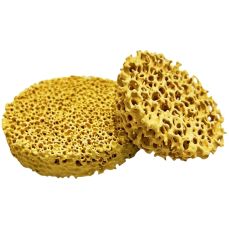
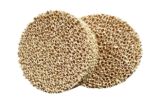
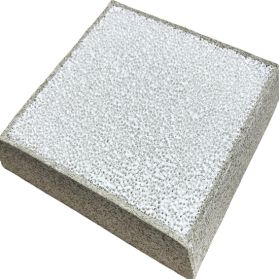
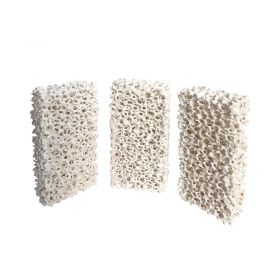
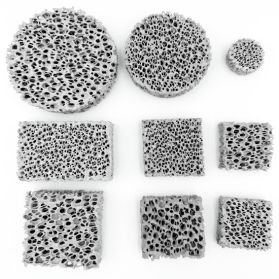
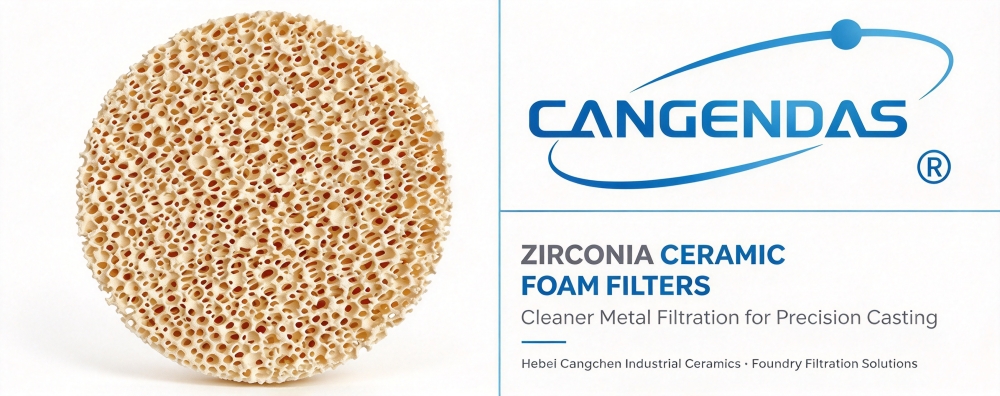
Zirconia ceramic foam filter is a three-dimensional, reticulated cellular structure produced from partially stabilized zirconia (ZrO₂).
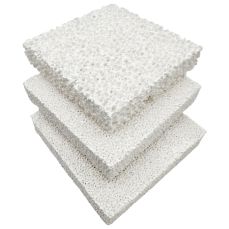
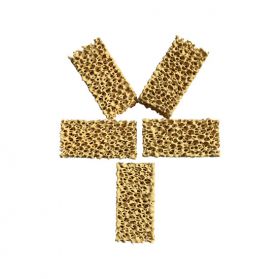
Picture a sponge with roughly 80–90% open porosity — a labyrinth of interconnected, 10–40 pore-per-inch (PPI) channels — fired into a dimensionally stable ceramic body that sits in the gating system, downstream of the sprue, upstream of the casting cavity.
| Parameter | Typical Range |
| Material | Partially stabilized zirconia (ZrO₂) |
| Max. service temperature | Up to ~1700°C (3092°F) |
| Porosity | >80% (typically 80–90%) |
| Pore density (PPI) | 10 / 15 / 20 / 30 (custom on request) |
| Cold crushing strength | ≥1.5 MPa |
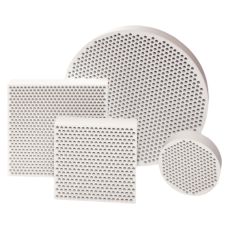
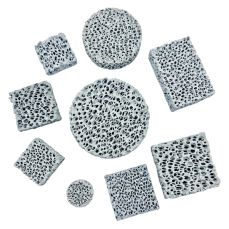
| Available shapes | Round, square, rectangular; customized sizes & thicknesses |
What can zirconia ceramic foam filter do?
1. Depth filtration (not just surface screening)
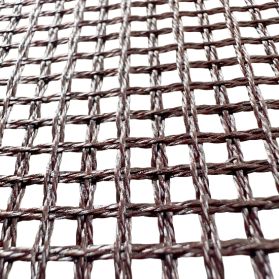
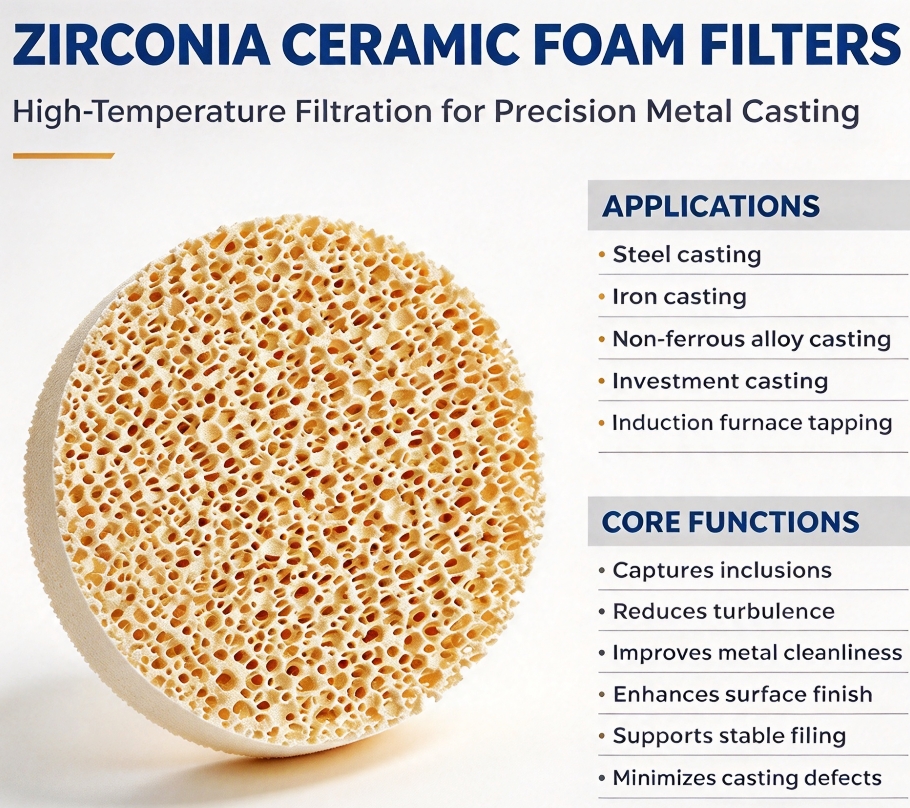
Inclusions — deoxidation products, eroded refractories, slag, mold sand — are caught throughout the filter's 3D body, not merely on one face. The tortuous path traps micron-scale particles of every shape, where a flat strainer or fiber mesh only skims the surface. In practice, this removes roughly 90–99% of non-metallic inclusions that would otherwise flow straight into the casting.
2. Flow conditioning
A raw pour is turbulent, uneven, and re-oxidizing. As metal passes through thousands of narrow pores, the jet is broken apart and recombined into a smooth, laminar, steadily accelerated stream. This does three things: it minimizes re-oxidation (less fresh oxide formed during pouring), it reduces mold erosion from a concentrated jet, and it stabilizes filling for repeatable quality from shot to shot.
3. Slag and dross rejection in the actual casting environment
Molten steel and superalloys are chemically aggressive. The partially stabilized zirconia composition is engineered to resist thermal shock on contact with a hot pour, and to resist attack and erosion by liquid slag — holding its shape and continuing to filter even in demanding high-temperature conditions.
4. Repeatability as a quality-control tool
Consistent filtration means consistent fill, which means consistent microstructure and mechanical properties across a run. You stop fighting "which heat is good today" and start quoting against a stable process.
Applications & Use Cases
| Metal / Process | Typical PPI | Typical Use |
| Carbon steel | 10–15 | Structural & general castings, high flow rate |
| Alloy steel | 10–20 | Inclusion control, higher-strength components |
| Stainless steel | 15–20 | Oxide & surface-quality control |
| Nickel / cobalt superalloys | 15–30 | Precision & investment castings, aerospace-grade |
| High-alloy / precision components | 20–30 | Fine filtration for maximum cleanliness |
Where you'll find them at work:
● Steel foundries — structural, wear-resistant and engineering castings
● Stainless & alloy foundries — valves, pumps, impellers, pipe fittings
● Superalloy / investment casting — turbine and aerospace components
● High-temperature alloy producers — marine, energy and power-generation parts
● Any shop casting thin-section or high-integrity components where inclusions mean rejection
The bottom-line effect on your floor:
● Fewer scrap and rework castings
● Reduced machining spoilage from hard inclusions
● Better surface finish and pressure-tightness
● Lower internal reoxidation and cleaner metallurgy
● A more stable, quotation-ready process
Choosing the Right Filter
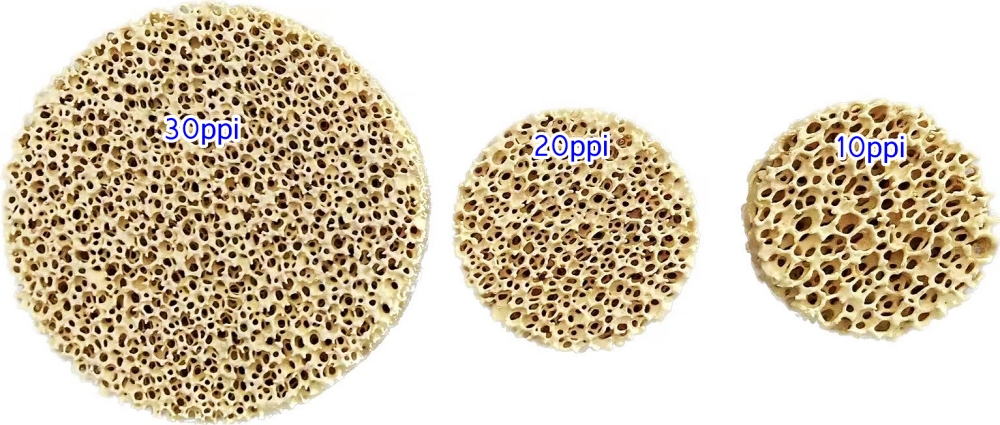
● 10 PPI — coarse filtration, maximum flow; heavy section castings
● 20 PPI — the balanced workhorse for most steel castings
● 30 PPI — fine filtration for precision, thin-section or high-integrity work
Size the filter face to your pouring rate and choose thickness for inclusion capacity without excessive pressure drop.
Behind our filters is a focused expertise — not on "ceramics in general," but on zirconia and ceramic filtration materials for the world's foundries.
● Export-first mindset. We speak the language of foreign foundries: English documentation, clear packing, correct HS classification, and shipping arranged so the goods arrive as ordered.
● Engineering support, not just boxes. Send us your part, your metal grade, and your pour temperature — we'll recommend the PPI, size and gating placement to fit your actual process, not a catalog guess.
● Custom sizes, made your way. Round, square, rectangular; your drawing, your dimension, your pore density. If it can be fired, we'll make it.
● Consistency that survives the heat. Batch-to-batch dimensional and porosity control is how we keep your process stable — because a filter you can't rely on is worse than no filter at all.
● A partner, not a transaction. Stable supply, honest lead times, and a response that treats your order as the start of a relationship, not the end of a sale.

How to Select The Correct Filter For Your Casting
Oct. 09, 2026
Contact Us
+86 158 3011 4065
Guoruiyuan Building, ShengLi North Street, Chang'An District, Shijiazhuang City, Hebei Province, China.
Navigation
Navigation