News
May. 20, 2026
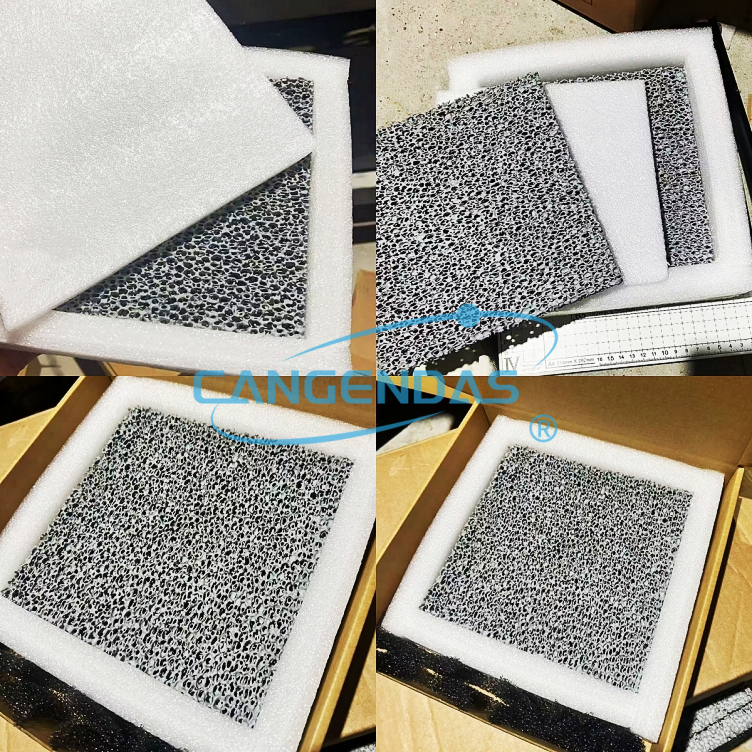
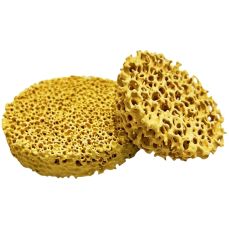
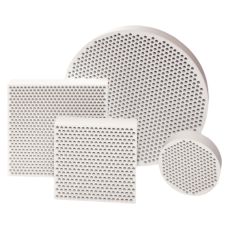
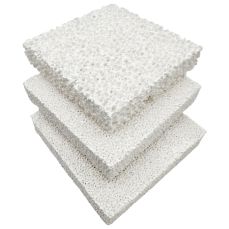
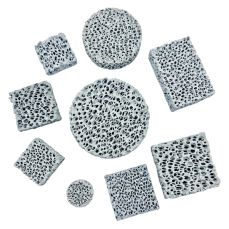
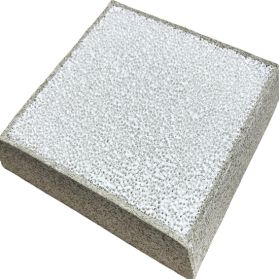
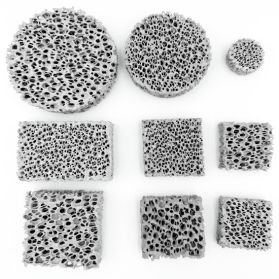
Silicon carbide ceramic filter are specialized core consumables for high-temperature casting of black metals.
● Main function is to purify molten iron and molten steel, remove oxide inclusions and slag, stabilize the casting flow rate, and solve common problems such as slag holes, gas pores, and porosity in castings from the source.
● Widely used in high-end casting fields, such as automotive parts castings, construction machinery castings, valve and pipe fittings, and rail transit castings.
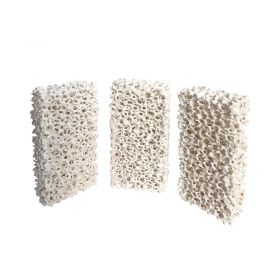
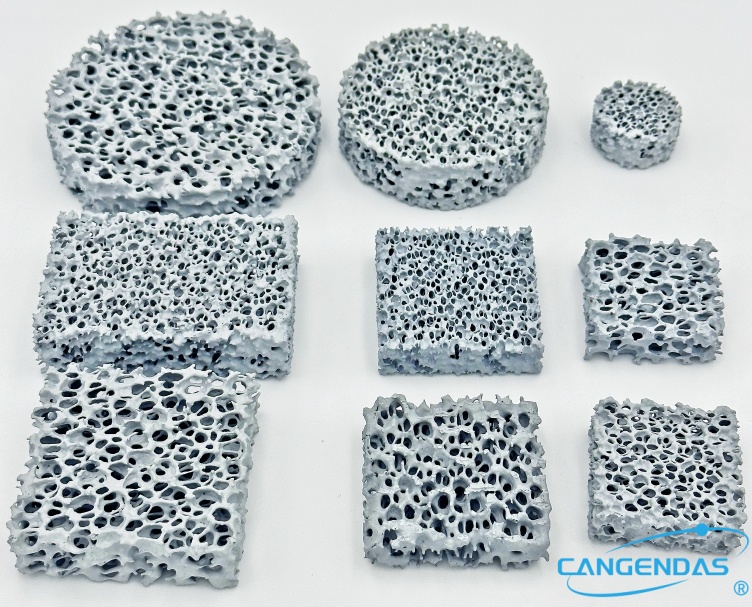
Silicon carbide ceramic filter is also called as SIC ceramic foam filter.
● Made from high-purity silicon carbide powder as the base material, combined with high-temperature binders and forming aids.
● Through mixing, foaming molding, low-temperature drying, and sintering at temperatures above 1600°C in a high-temperature atmosphere, formed into three-dimensional, net-like, multi-porous ceramic filter elements.
● They are the mainstream liquid metal purification consumables in the high-temperature casting industry.
Raw material ratio → Stirring and mixing → Organic foaming for pore formation → Mold shaping → Natural air-drying → Low-temperature drying and degassing → High-temperature sealed sintering → Grinding and trimming → Dimension sorting → Quality inspection and packaging.
● No harmful substances are added throughout the process.
● After sintering, the structure is dense, the pores are transparent, and the strength is stable.
1. High-temperature resistance performance.
● The maximum operating temperature is 1550℃.
● It can withstand the erosion of molten cast steel, cast iron, and high-temperature copper alloy for a long time without softening or deforming.
2. Thermal shock resistance.
● Excellent resistance to rapid cooling and heating.
● No cracking or slagging occurs during the casting process, making it suitable for continuous production on assembly lines.
3. Chemical Stability.
● Resistant to high-temperature oxidation
● Resistant to erosion by molten metals
● Resistant to acid and alkali erosion, does not react chemically with molten iron, molten steel, or copper liquid, and no impurities are released.
4. Structural Advantage.
● There is a porosity of up to 80% to 90% of three-dimensional interconnected network structure.
● It has low flow resistance, does not cause blockage or stagnation of the flow, and does not affect the casting speed.
5. Mechanical Strength.
● The overall hardness is high, with excellent resistance to pressure and impact.
● During the process of handling, placing, and pouring, it is unlikely to be damaged or produce debris.
6. Air permeability and liquid permeability.
● The holes are evenly distributed, allowing for smooth flow of fluids.
● It has the dual functions of filtration and stable flow.
1. Iron casting industry: Various castings of ductile iron, gray iron, and vermicular graphite iron.
2. Cast Iron Industry: Precision castings of carbon steel, alloy steel, and stainless steel.
3. Colored casting: Filtering of high-temperature molten liquid of copper alloys, brass, and bronze.
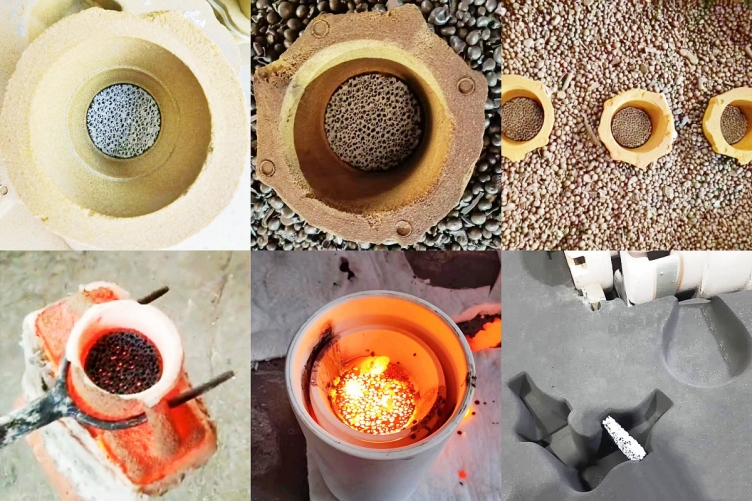
1. Mechanical filtration: To prevent large impurities such as slag, oxide scale, and sand particles from the liquid metal.
2. Deep adsorption: Fine non-metallic inclusions are adsorbed onto the inner wall of the silicon carbide framework, achieving deep purification.
3. Turbulent flow rectification: Disrupt the chaotic vortex of the molten metal, straighten the flow direction, and reduce slag and gas entrainment;
4. Smooth flow control: Maintain a stable flow rate, ensuring a full filling of the casting and minimizing the occurrence of underfilling defects.
1. Before use, it can be preheated at a low temperature to avoid cracking due to sudden cooling.
2. Handle with care to avoid any damage caused by corner impacts.
3. Do not store in water or in damp conditions; keep it dry and well-ventilated.
4. Select the PPI aperture size based on the size and purity requirements of the casting.
5. It should be used for a single casting.
6. It is not recommended to reuse it for a second time.
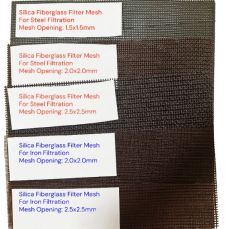
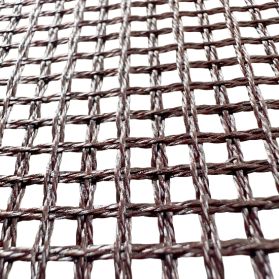
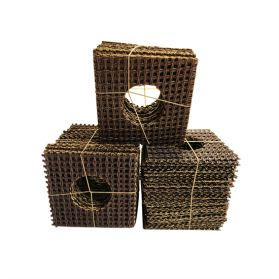
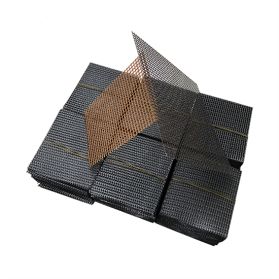
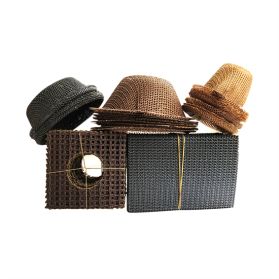
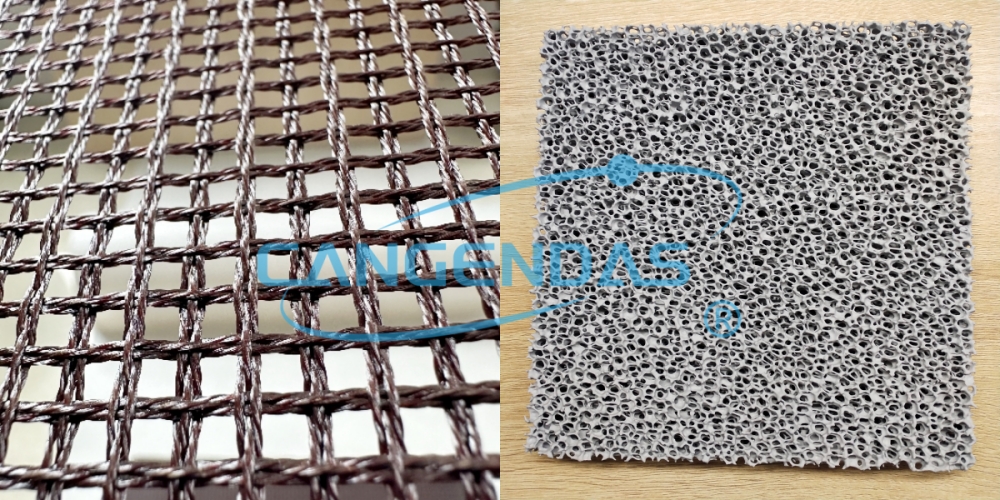
| Comparisons | High-silica Fiberglass filter mesh | SIC Ceramic foam filter |
| Material & Structure | The flexible woven fiber mesh structure that can be cut and folded at will, and it is tough material. | Rigid three-dimensional connected foam ceramic skeleton, fixed and formed, hard and brittle, not bendable. |
| Applicable temperature | Working temperature is 1300-1400℃, and it can withstand a short-term high temperature of 1600℃. It remains stable at high temperatures for short periods. | Working temperature is 1500-1560℃, with stronger high-temperature resistance and stable pouring state throughout the process. |
| Filter principle | Surface screening and filtration mainly rely on physical interception. | Surface interception + three-dimensional deep adsorption filtration, dual purification effect. |
| Filter fineness | Coarse filtration, intercepting large particles of slag, molding sand and inclusions ranging from 20 to 100μm. | Fine filtration can intercept fine oxide inclusions and micro-residues smaller than 10μm. |
| Thermal shock resistance | Extremely excellent, it does not crack under sudden temperature changes and is suitable for frequent intermittent pouring. | Excellent, stable in high-temperature cycling, and less prone to cracking during continuous pouring. |
| Erosion resistance strength | It has good toughness, but it is not resistant to long-term and high-speed molten iron erosion. It is prone to slight deformation after being poured at high temperatures for a long time. | The high-temperature structural strength is extremely high, resistant to high-speed erosion by molten iron, without shedding slag or getting damaged. |
| Rectification effect | Moderate, it can reduce the turbulence of molten iron and decrease the amount of gas entrainment. | Excellent, three-dimensional labyrinth structure for powerful rectification, ensuring more stable and uniform filling of castings. |
| Gas volume | Extremely low (≤0.8mL/g), and less prone to porosity defects. | Almost zero gas generation, no decomposition at high temperatures, and no volatile impurities. |
| Installation compatibility | It has extremely high flexibility, can be freely cut, and is suitable for any gate without the need to change the tooling. | The fixed specification and size must match the size of the pouring system. Installation should be protected from bumps and fractures. |
| Core advantages | 1. Cost performance. 2. Flexible thermal shock resistance, no risk of explosion 3. Easy installation, suitable for all small batch sizes.4. It has low resistance, does not clog the flow and does not affect the pouring speed. | 1. High filtration accuracy, significantly enhancing molten iron.2. Stable high-temperature strength.3. Powerful rectification, improving castings.4. Significantly reduce precision defects such as pores, inclusions and slag holes. |
| Main shortcomings | 1. It cannot filter fine particles. 2. It is not resistant to long-term high-temperature erosion and is only suitable for short-term use. 3. It has limited improvement on high-end precision castings | 1. High unit price, high overall usage cost. 2. Brittle material, difficult to transport. 3. The specifications are fixed and the irregular-shaped runner cannot be adapted. |
| Best applicable scenarios | 1. Common gray cast iron castings, medium and small-sized ones. 2. Those with strict cost control. 3. Intermittent and short-time pouring process. | 1. Ductile iron, high-end precision cast iron parts, large-sized thick-walled parts. 2. High request for strength and toughness of castings.3. Continuous pouring and high-speed flow rate pouring process |
| Recommended matching plan | Used alone: Ordinary civilian and general mechanical cast iron parts. | Use alone: High-end precision castings. 2. Use in combination: high-silicon oxygen coarse filter at the front end + silicon carbide fine filter at the back end (ultimate purification) |
How to Select The Correct Filter For Your Casting
Oct. 09, 2026
Why use TF COMBO BAG for molten aluminum
Oct. 01, 2026
Contact Us
+86 158 3011 4065
Guoruiyuan Building, ShengLi North Street, Chang'An District, Shijiazhuang City, Hebei Province, China.
Navigation
Navigation