News
Nov. 21, 2026
Gating-system filtration is a process intervention rather than an accessory. Its objective is to reduce the non-metallic inclusion population that reaches the mold cavity with the metal stream. This note addresses three questions: which inclusions a high-silica fiberglass medium removes, by which mechanisms removal occurs, and which changes are subsequently observed in the casting. Parameters and placement are stated for steel, iron and copper alloy casting.
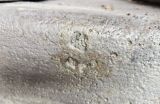
Steel pours with no filter in the gating system kept one foundry fighting the same defects every heat: pinholes, rough patches and slag spots that only surfaced after shot blasting or the first machining pass.
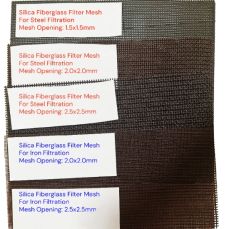
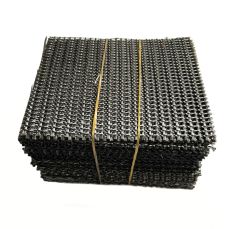
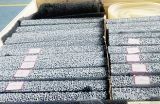
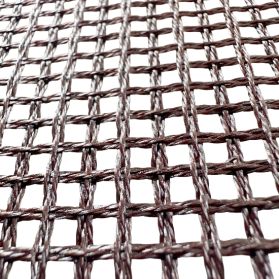
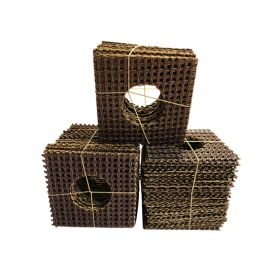
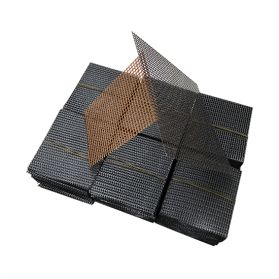
In November 2026 the foundry ordered high-silica fiberglass filter mesh, 2.5 mm opening, rectangle sheets, and now running trial pours against its own unfiltered baseline.
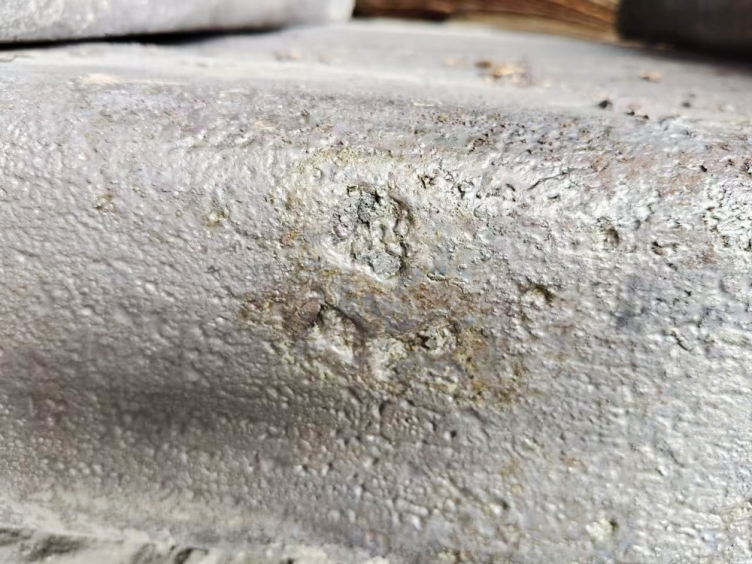
(Unfiltered steel casting: pinholes, rough patches, and slag traces (Customer Photo))
Inclusions entering a steel casting derive from four sources:
deoxidation products generated during ladle treatment;
reoxidation products formed during transfer, teeming and mold filling;
refractory fragments from ladle and furnace lining erosion;
mold material—sand, wash and coating—detached by the metal stream.
These phases are not soluble at pouring temperature, and they do not separate within the residence time available in the gating system. Their final distribution is therefore governed by the flow path and the solidification sequence rather than by density difference alone. An unfiltered gating system delivers a comparable inclusion load to comparable locations heat after heat, which is why defect patterns repeat under otherwise stable process conditions.
● Interception.
The medium is installed as a permeable barrier across the flow section. Particles whose characteristic dimension exceeds the aperture are retained at the upstream surface. Interception governs the removal of coarse slag, sand and refractory fragments, and it is the mechanism most commonly specified in purchasing documents.
● Depth filtration.
A woven medium is a three-dimensional fibrous structure; flow paths through it are non-linear and the pore network is tortuous. Particles smaller than the nominal aperture are retained by inertial impaction and adhesion at fiber surfaces within the medium. Depth filtration accounts for the removal of fines below the rated aperture; its contribution depends on medium thickness and on the uniformity of the flow path through the cloth.
● Flow conditioning.
Downstream of the medium, jet characteristics of the metal stream are attenuated and the velocity profile at the ingate becomes more uniform. Reduced turbulence lowers air entrainment and the formation of oxide bifilms during mold filling. Bifilms are subsequently associated with surface blistering, crack initiation and defects exposed only after machining.
Medium performance is bounded by softening behavior. A medium whose softening temperature lies below the pouring temperature loses mechanical integrity in the runner and contributes vitreous fragments to the inclusion population; filtration then becomes a contamination source rather than a control measure. High-silica fiberglass with SiO2 ≥96% maintains structural integrity throughout the contact interval, does not shed fiber into the stream, and retains its aperture under the thermal load of the pour.
● Aperture selection: governed by pour rate, casting weight and gating section rather than by filtration fineness. A 2.5 mm aperture maintains fill time comparable to unfiltered practice, which limits the need for gating modification and isolates filtration as the single process variable under evaluation.
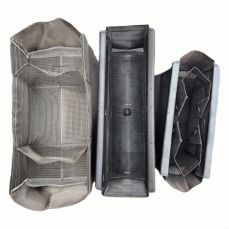
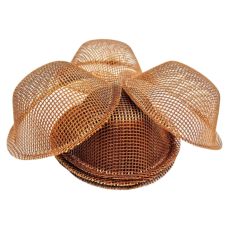
● Placement: pouring cup, sprue base, or runner upstream of the ingate—positions where inclusion concentration and turbulence are highest, and where a defined flow path through the medium exists. A medium laid across a wide, low-velocity section operates well below its removal capacity.
Filtration efficiency in gating practice is not a single number. It is the fraction of a given inclusion size class retained by the medium under a given flow condition, and it varies with aperture, medium thickness, approach velocity and inclusion morphology.
A finer aperture raises the interception cut-off and therefore the retained fraction of coarse inclusions, but it also raises flow resistance. The resulting pressure drop lengthens fill time, lowers metal temperature at the ingate and increases the risk of cold shuts in thin sections. Efficiency gained at the top of the size distribution is thus offset by fill-related defects at the lower end of the section thickness range.
Efficiency is also flow-dependent. At high approach velocity, inertial impaction increases while residence time decreases and previously retained particles may be re-entrained into the stream. At low velocity, adhesion dominates and retention is more stable, although throughput falls. The same cloth therefore performs differently at the pouring cup and in a wide, low-velocity runner section.
Aperture selection proceeds from the constraint rather than from the target. Fill time and minimum section thickness define the maximum acceptable resistance; the inclusion size class to be controlled defines the minimum acceptable cut-off. The working aperture lies between those two limits. For heavy sections and high pour rates, 2.5 mm satisfies both; in thin-section work, the filling constraint usually sets the aperture before the cleanliness target does.
Efficiency is verified on the foundry’s own pattern. Comparative heats at constant pouring temperature, with and without the medium, isolate the effect on the defect population; metallographic sectioning or inclusion rating on a sampling basis quantifies the change. A single trial casting does not establish efficiency, whereas a series across the pour weight range does.
Effects are recorded at successive process stages: a reduction in surface pinholes and slag traces after shot blasting; a reduction in subsurface inclusions exposed by machining, with a corresponding increase in cutting insert life; a reduction in radiographic and ultrasonic indications; improved filling of thin sections without cold shut formation; and reduced grinding and weld repair hours.
Contact Us
+86 158 3011 4065
Guoruiyuan Building, ShengLi North Street, Chang'An District, Shijiazhuang City, Hebei Province, China.
Navigation
Navigation