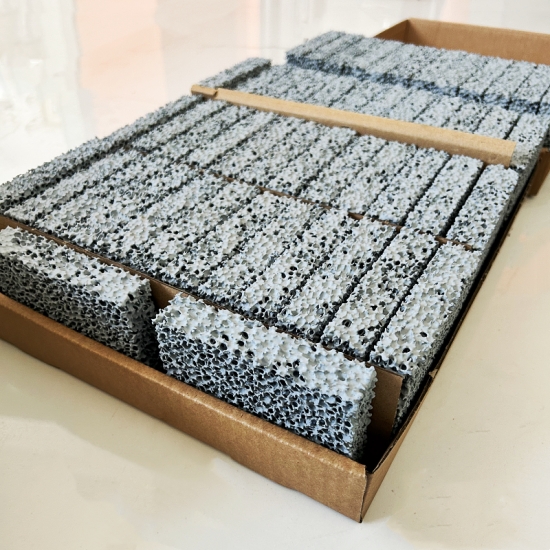
Ceramic Foam Filter
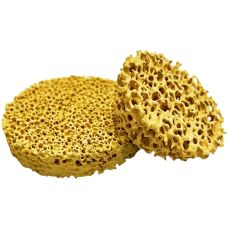
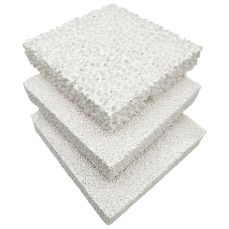
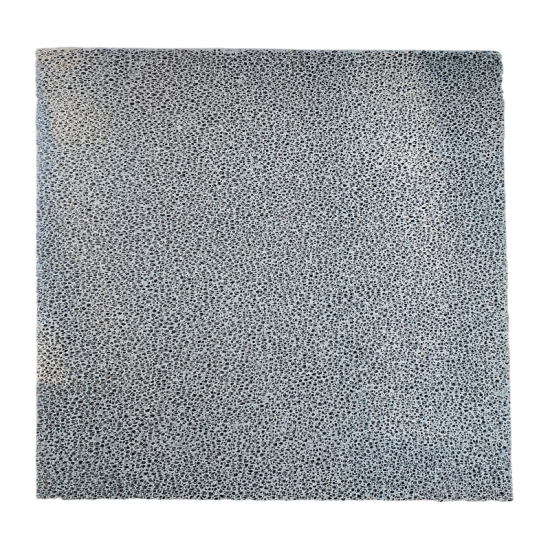
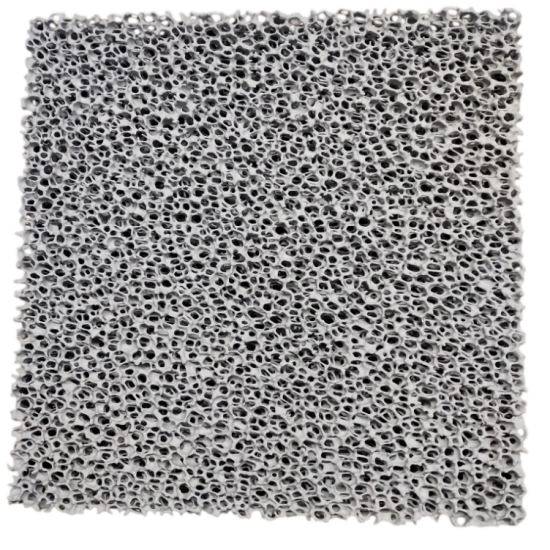
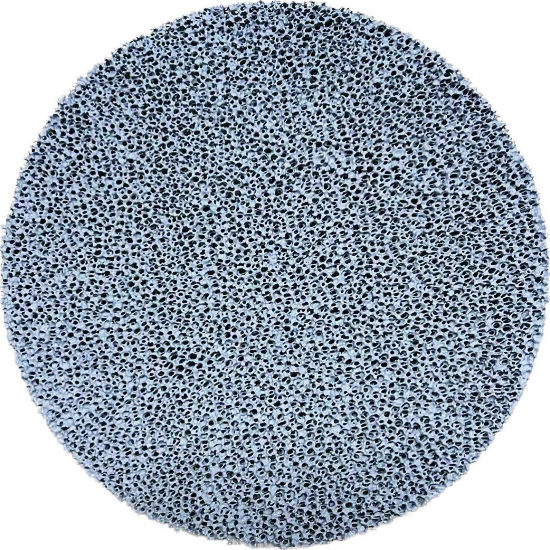
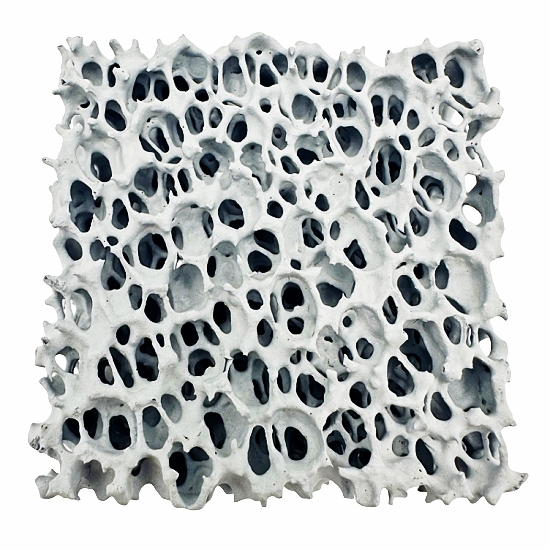
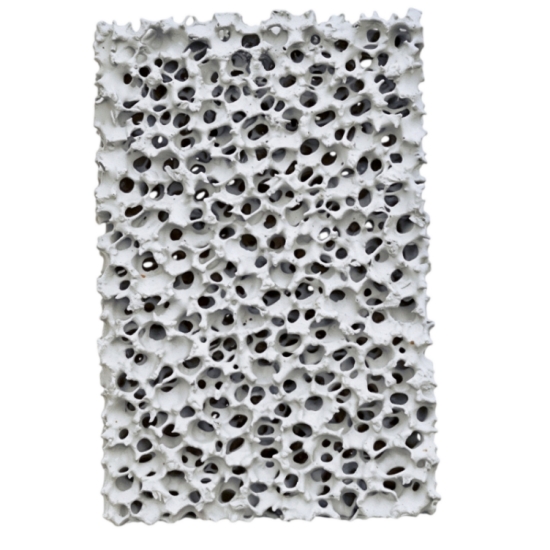
A rigid three-dimensional open-cell ceramic foam filter made from silicon carbide (SiC), designed for in-mold depth filtration of gray iron, ductile iron, malleable iron, brass, bronze, and other copper alloys. As molten metal passes through the interconnected pore network, slag, magnesium reaction products, inoculant residues, sand grains, and oxide films are retained throughout the foam depth, while the outflow is regulated into a smooth, laminar flow.
● Depth filtration through the full foam thickness — fine particles below the nominal pore opening are captured inside the body, not only coarse slag on the entry face
● Rigid SiC ceramic body — withstands metal head pressure and erosion through the entire pour without cracking or softening
● Heat- and slag-resistant — continuous service around 1500 °C, resistant to attack by iron, copper, slag, and dross, with no particles shed into the casting
● Laminar filling through the foam matrix — flow resistance evens out the jet and lowers the Reynolds number, reducing secondary oxidation and mold erosion
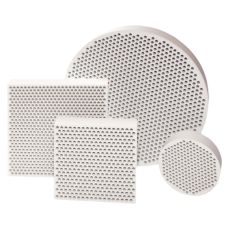
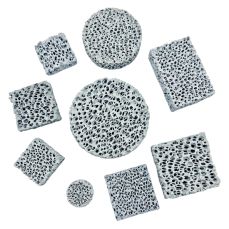
● Square, round, and custom shapes — installed at the sprue base, in the runner, or in filter boxes, vertically, horizontally, or diagonally
Suitable for gray iron, ductile iron, malleable iron, compacted graphite iron, brass, bronze, and copper alloys. Pore densities from 10 to 30 PPI, in standard and custom sizes. The filter can also be used for small steel castings within the temperature limit.
Description
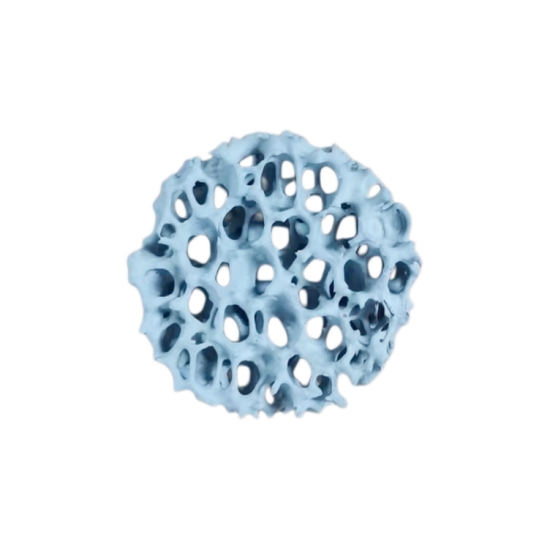
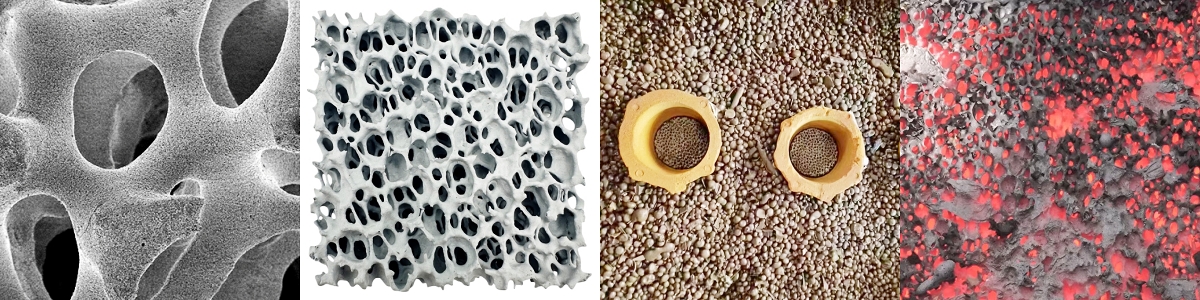
This filter is manufactured from silicon carbide (SiC) ceramic bonded with a high-temperature refractory binder. A reticulated polyurethane sponge is impregnated with a SiC ceramic slurry, dried, and sintered at high temperature. The polymer skeleton is burned out during firing, leaving a rigid ceramic foam with an open, interconnected pore network that mirrors the original sponge geometry.
Silicon carbide itself combines high refractoriness, high thermal conductivity, high hardness, and a low coefficient of thermal expansion — properties that give the foam its thermal shock resistance, erosion resistance, and load-bearing strength under iron and copper-alloy pouring.
The SiC binder system is selected for the demands of ferrous and copper-alloy pouring:
● Temperature margin. The filter withstands continuous service at approximately 1500 °C, with short-term resistance up to about 1560 °C — a safety margin above the normal pouring temperatures of gray iron, ductile iron, and copper alloys.
● Thermal shock resistance. The rigid body survives the sudden first contact with hot metal without cracking, which is critical for long fill times and high-impact runner positions.
● Chemical resistance. SiC is resistant to attack by molten iron, copper alloys, slag, and dross. The filter does not degrade, shed particles, or react with the metal, so no filter material is released into the casting.
● Cold crushing strength. The foam retains enough strength to withstand handling and the metal head pressure of a heavy casting without collapsing or tilting in the seat.
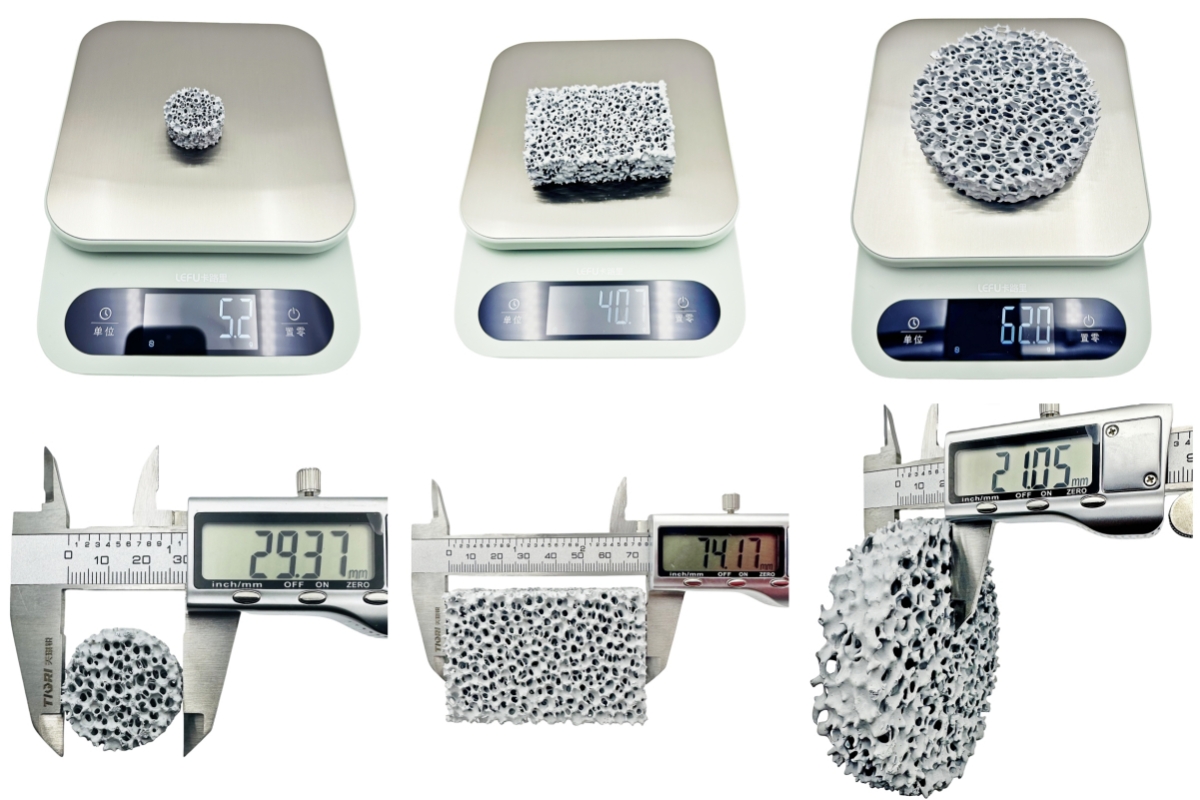
Standard porosity ranges from 80% to 85%, with a bulk density of 0.55–0.65 g/cm³. The open-cell structure provides a large internal contact surface on which non-metallic inclusions can be captured throughout the filter depth.
The filter can also be used for small steel castings within this temperature range. For high-temperature carbon steel, alloy steel, and stainless steel poured at 1550–1650 °C, zirconia (ZrO₂) foam filters are the recommended choice.
| Item | Details |
| Material | Silicon carbide (SiC) ceramic foam, high-temperature refractory bond |
| Maximum application temperature | ~1500 °C |
| Typical pouring range | Gray iron 1300–1400 °C · Ductile iron 1400–1500 °C · Copper alloys 1000–1200 °C · Small steel castings up to ~1500 °C |
| Pore density | 10 / 15 / 20 / 25 / 30 PPI (custom PPI on request) |
| Porosity | 80–85% |
| Bulk density | 0.55–0.65 g/cm³ |
| Metal load | ~4 kg/cm² gray iron; ~2 kg/cm² ductile iron |
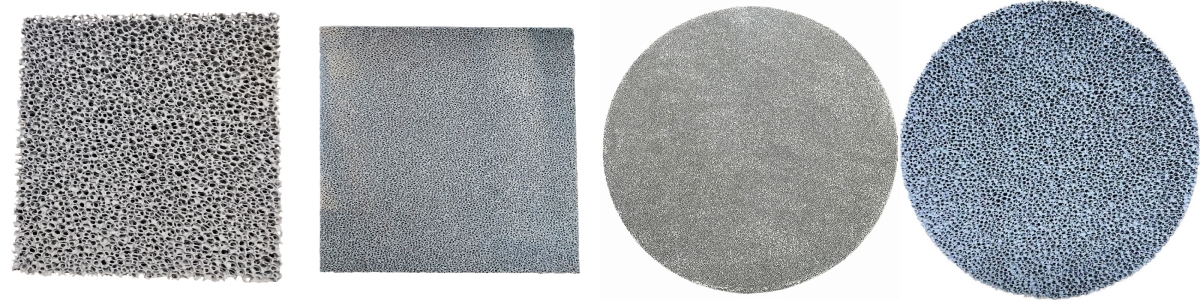
| Shapes | Square, round, and custom geometric shapes |
| Size range | 40–584 mm (1.5"–23") per side; custom cut on request |
| Thickness | 10–50 mm |
| Single use | Yes, disposable |
| Preheat requirement | 300–500 °C for iron and small steel castings; 150–200 °C for copper alloys |
Gray iron carries flake graphite clusters, slag, and eroded mold sand; ductile iron introduces magnesium oxide and magnesium sulfide reaction products, MgO–MgS slag, and inoculant residues; copper alloys carry oxide skins, dross, and fragments of flux and refractory wash. These particles are picked up from the melt charge, transfer ladles, and pouring stream. Once this material enters the mold cavity, it solidifies as slag holes, sand inclusions, subsurface oxide defects, and pressure leaks. Such defects are often found only during radiographic inspection, pressure testing, or first-piece machining, when a rejected casting already carries the accumulated cost of casting, machining, handling, and delivery.
Iron and copper-alloy pouring places two specific demands on the filter:
First, the metal reaches the runner with considerable head pressure and velocity, so the filter body must remain rigid and intact under this load rather than deforming or eroding.
Second, the inclusion size range is wide: coarse slag agglomerates travel together with thin oxide films and fine particles that are far smaller than any single pore opening. A three-dimensional foam structure addresses this range by retaining inclusions throughout its depth — including particles smaller than the nominal pore opening — instead of sieving them only at a single surface.
The open foam matrix also regularizes the flow in the gating system. As the melt passes through the strut network, its velocity is evened out and the Reynolds number is lowered, so the cavity fills steadily rather than under a fluctuating jet. Because the rigid SiC body holds its shape and seat throughout the pour, the runner system can often be designed with a smaller cross-section than an unfiltered equivalent.
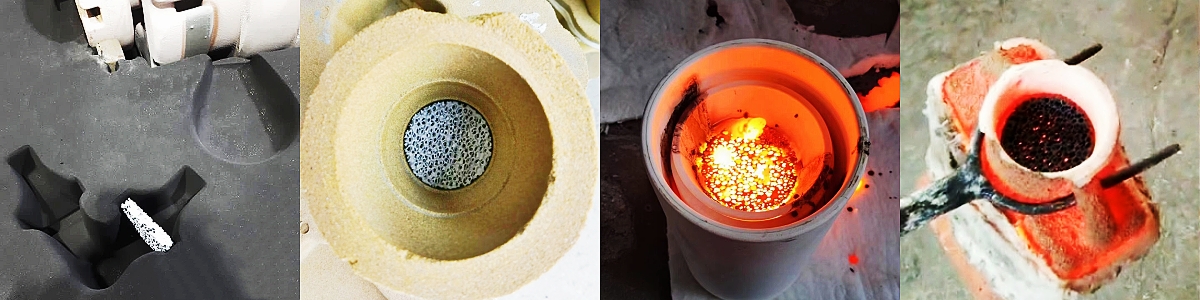
As metal flows through the interconnected pore network, the foam combines two capture mechanisms with settling and flow straightening:
1. Mechanical sieving. Particles larger than the pore openings — slag agglomerates, oxide skins, eroded sand grains, and refractory wash fragments — are physically blocked at or near the entry face of the foam and accumulate there.
2. Depth filtration. This is the principal capture mechanism in a ceramic foam filter. Fine inclusions follow the tortuous path through the interconnected strut network; the metal repeatedly changes direction and velocity, so particles collide with the ceramic struts and adhere to the pore walls by surface-tension and van der Waals forces. Because capture occurs throughout the full thickness of the foam, inclusions considerably smaller than the nominal pore opening are retained. In properly sized filters, the majority of inclusion removal is reported to come from this depth effect rather than from surface sieving alone.
3. Settling effect. Flow velocity drops as the melt passes through the resistance of the foam matrix. Particles heavier than the melt are given the opportunity to settle onto the struts before the metal leaves the filter.
4. Flow straightening. The porous foam breaks up the incoming stream into a number of parallel sub-streams, lowering the Reynolds number and promoting laminar filling. With turbulence reduced after the filter, secondary oxidation before the cavity is held down, and light inclusions are permitted to rise before the melt exits the foam rather than being entrained into the casting by a turbulent stream.
In ductile iron, the three-dimensional pore network captures magnesium oxide, magnesium sulfide, and magnesium reaction products together with inoculant residues before these particles enter the cavity — a main source of sub-surface inclusions, pinholes, and drossy surfaces in nodular iron castings.
1. Casting processes
● Sand casting (green sand, resin sand, furan, no-bake) — primary application for gray and ductile iron
● Gravity die casting / permanent mold — copper alloys
● Shell molding — selected medium-section parts
2. Common castings
● Gray iron: Engine blocks, cylinder heads, brake discs, brake drums, transmission housings, pipes, fittings, flanges, machine beds, cookware, counterweights
● Ductile iron: Valve bodies, pump housings, brackets, hubs, wind turbine hubs, gears, automotive suspension and structural parts, pipe fittings
● Copper alloys: Bearings, bushings, valve bodies, gears, electrical components, marine hardware, water fittings
● Small steel castings (within temperature limit): Valves, fittings, hardware. For critical and high-temperature carbon steel, alloy steel, and stainless steel, zirconia foam filters are recommended.
3. Compatible alloys
● Gray cast iron (GG20, GG25, GG30), ductile iron (GGG40, GGG50, GGG60), malleable iron, compacted graphite iron
● Brass, bronze (tin bronze, aluminum bronze), copper-based alloys
Pore density (PPI) by alloy and casting type.
| Application | Recommended PPI |
| Ductile iron, large or heavy sections, high throughput | 10 PPI |
| Gray iron, standard sections; ductile iron, standard sections | 10–15 PPI |
| Gray iron, thin walls (<8 mm) / automotive quality | 15–20 PPI |
| Ductile iron, thin walls / pressure-tight parts | 15–20 PPI |
| Malleable iron, high-integrity or pressure-tight castings | 20–25 PPI |
| Brass, bronze, copper alloys | 15–25 PPI |
| Small steel castings (within temperature limit) | 15–20 PPI |
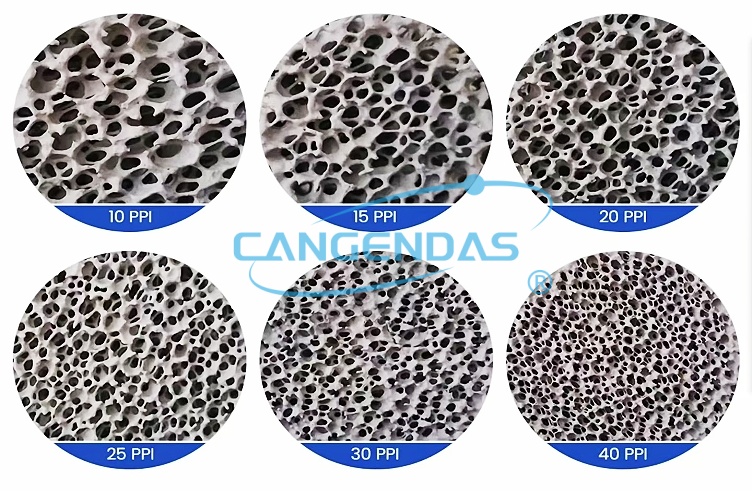
● Lower PPI means larger pores, faster filling, and higher metal throughput;
● Higher PPI means finer filtration and cleaner metal for precision or pressure-tested parts.
A PPI grade that is too fine for a melt carrying coarse, sticky dross will load quickly on the entry face, restrict flow, and cause misruns — for heavy ductile iron castings, start with the coarser 10 PPI grade and move finer only when the incoming metal is clean enough to support it.
1. What is the difference between SiC and ZrO₂ ceramic foam filters?
SiC (silicon carbide) filters are intended primarily for gray iron, ductile iron, and copper alloys, with a maximum application temperature of about 1500 °C, and can also be used for small steel castings within this range.
Zirconia (ZrO₂) filters are the preferred choice for carbon steel, alloy steel, and stainless steel poured at 1550–1650 °C.
2. Can SiC filters be used for steel castings?
Yes, SiC filters can be used for small steel castings poured within the temperature limit of about 1500 °C. For carbon steel, alloy steel, or stainless steel poured above 1550 °C, zirconia foam filters are the preferred choice.
4. How big should the filter be?
The filter's free flow area should be 4–6 times the choke area of your gating system. Filter size is also limited by the metal load: about 4 kg/cm² for gray iron applications and about 2 kg/cm² for ductile iron applications.
5. Do I need to preheat the filter?
Yes. Iron and small steel filters should be preheated to 300–500 °C, typically held 30–45 minutes before the pour; copper alloy filters to 150–200 °C. Preheating prevents thermal shock on first contact and avoids moisture-related gas defects.
6. Can custom sizes and shapes be supplied?
Yes. Square, round, and custom geometric shapes are available across the 40–584 mm range. Send your drawing or gating dimensions for a recommendation.
Application:
Suitable for gray iron, ductile iron, malleable iron, compacted graphite iron, brass, bronze, and copper alloys.
The filter can also be used for small steel castings within the temperature limit.


Look forward to hearing from you:
Contact Us
+86 158 3011 4065
Guoruiyuan Building, ShengLi North Street, Chang'An District, Shijiazhuang City, Hebei Province, China.
Navigation
Navigation