Ceramic Foam Filter
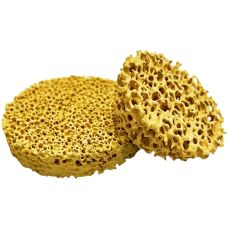
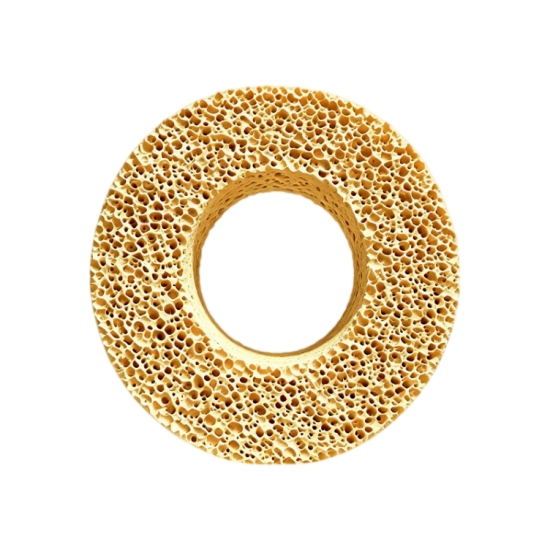
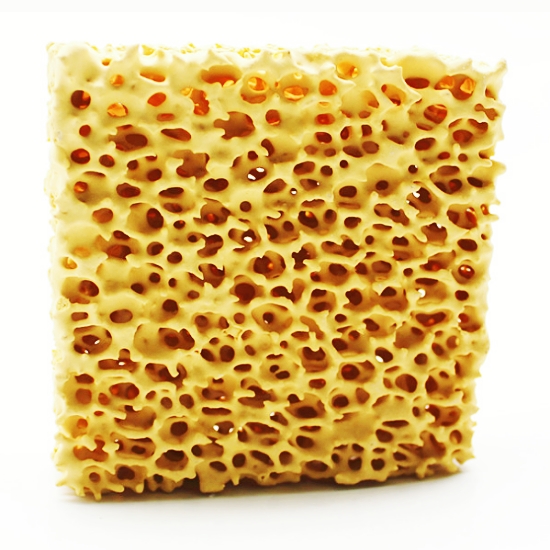
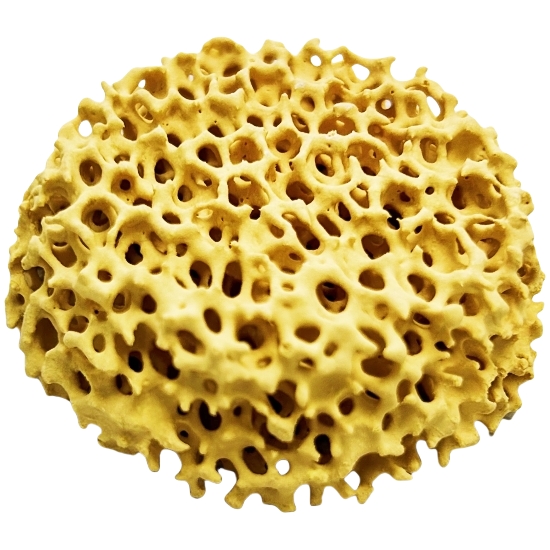
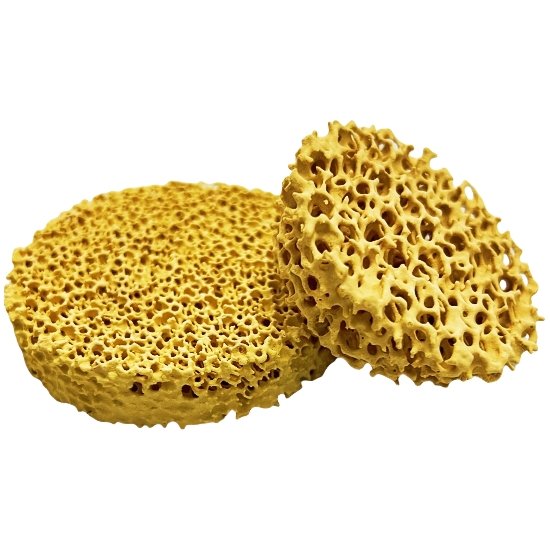
A high-temperature reticulated ceramic foam filter made from stabilized zirconia (ZrO₂), designed for in-mold depth filtration of carbon steel, alloy steel, stainless steel, and high-temperature superalloys poured at 1550–1650 °C. As molten steel passes through the interconnected pore network, deoxidation products, oxide clusters, sulfide inclusions, ladle slag, and eroded mold material are retained throughout the foam depth, while the outflow is straightened into a smooth, laminar flow that reduces re-oxidation and mold erosion.
● Service to 1700 °C — stabilized zirconia remains rigid and inert through the highest steel pouring temperatures, where lower-temperature foam materials would soften or react
● Depth filtration through the full foam thickness — fine inclusions below the nominal pore opening are captured inside the strut network, not only coarse slag on the entry face
● High compressive strength at temperature — the body withstands the first metal surge and the metal head pressure of heavy steel castings without crumbling or shedding fragments
● Chemical inertness in steel — zirconia does not react with molten steel, slag, or refractory wash; no ceramic material is released into the casting
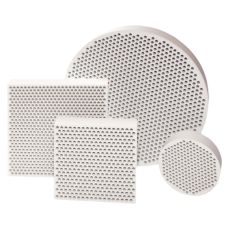
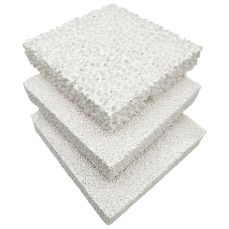
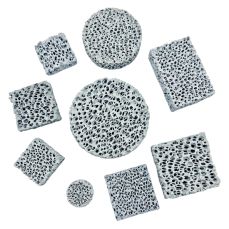
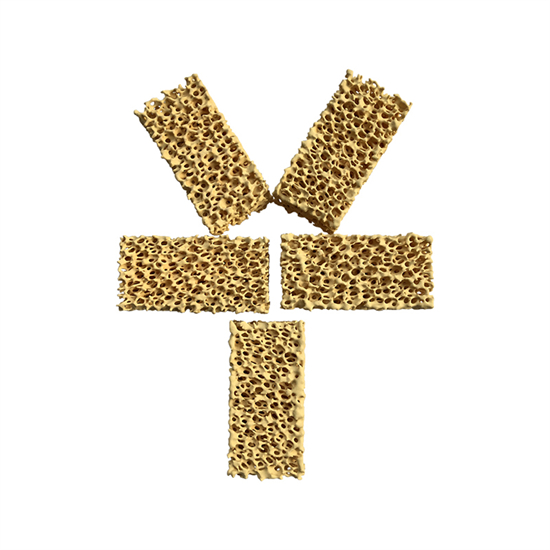
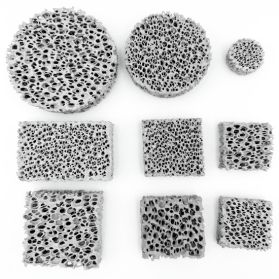
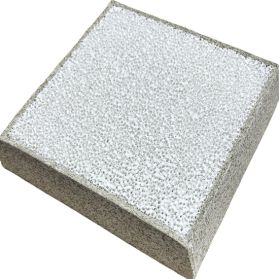
● Square, round, and custom shapes — installed at the sprue base, in the runner, or in filter boxes, for sand casting and investment casting
Suitable for carbon steel, alloy steel, stainless steel, and nickel- or cobalt-based superalloys. Pore densities from 10 to 30 PPI, in standard and custom sizes.
Description
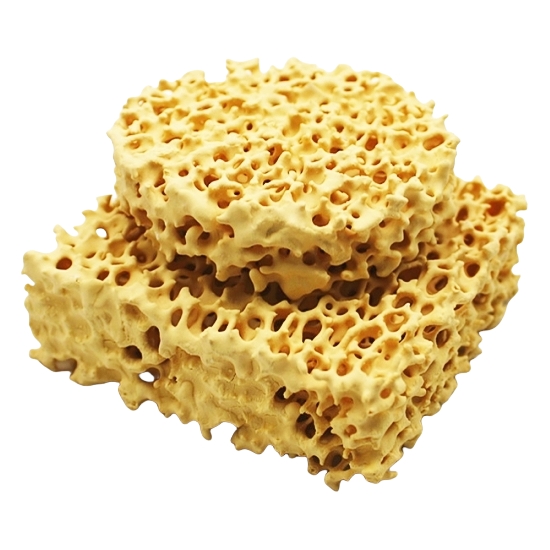
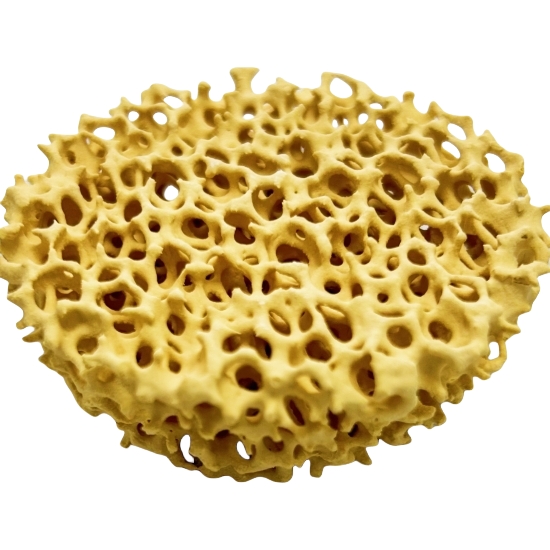
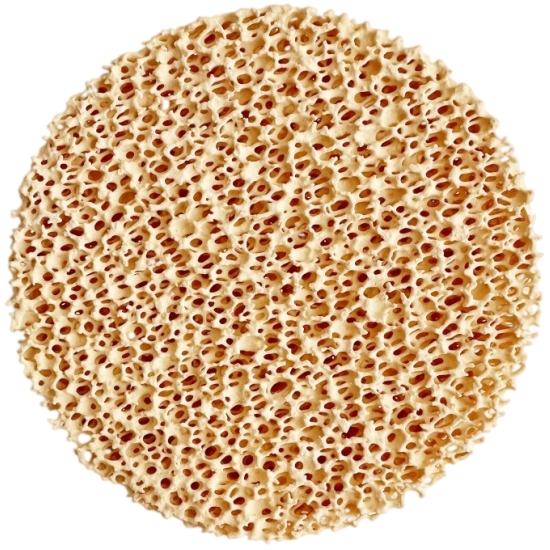
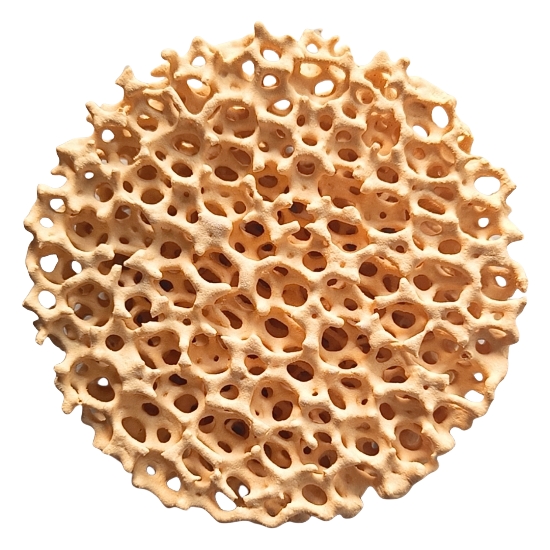
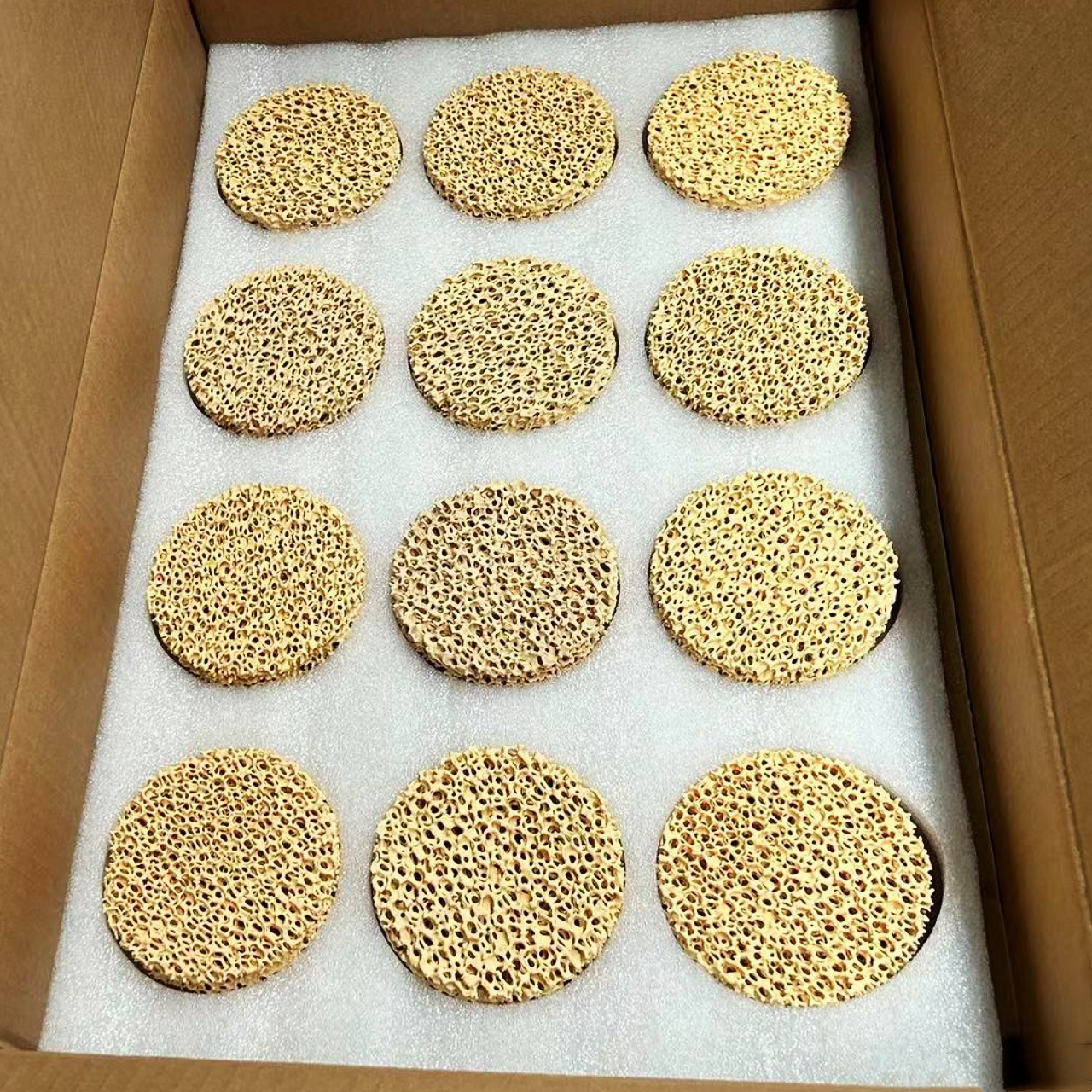
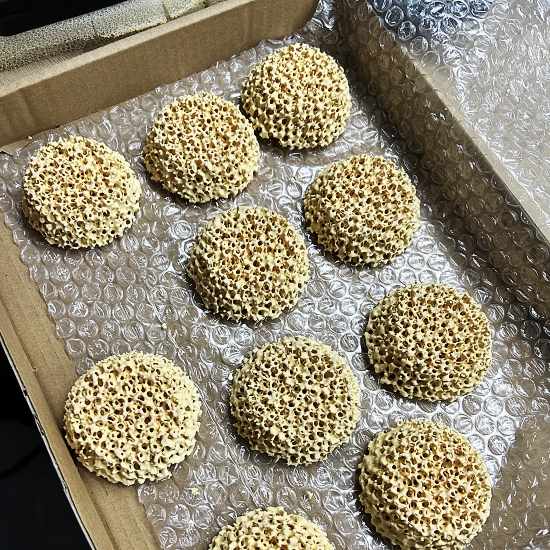
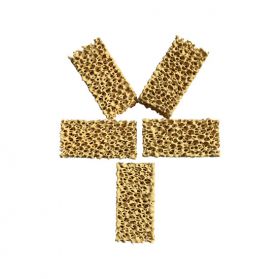
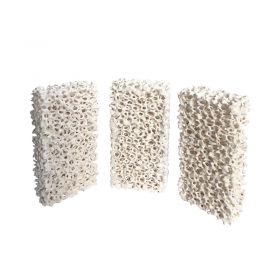
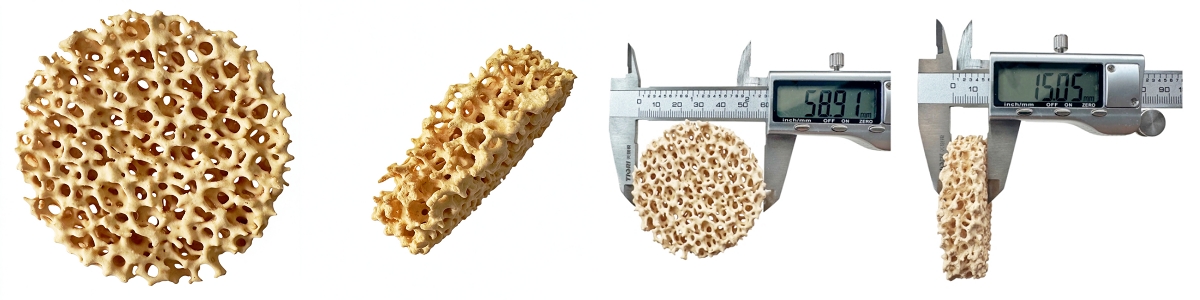
This filter is manufactured from partially stabilized zirconia (ZrO₂) ceramic. A reticulated polyurethane sponge is impregnated with a zirconia slurry, dried, and sintered at high temperature. The polymer skeleton is burned out during firing, leaving a rigid, light-yellow to cream-colored ceramic foam with an open, interconnected pore network.
Zirconia alone undergoes a volume-changing phase transformation between monoclinic and tetragonal crystal forms on heating and cooling, which would crack the foam under thermal cycling. To prevent this, the zirconia is stabilized with magnesia (MgO) — or yttria (Y₂O₃) in premium grades — so that the high-temperature crystal structure is retained at room temperature and the body survives repeated contact with molten steel without cracking.
Zirconia is selected for steel casting for four reasons:
● Temperature capability. The filter withstands continuous service at about 1700 °C, well above the 1550–1650 °C pouring range of carbon steel, alloy steel, and stainless steel. Zirconia melts at about 2715 °C, leaving a wide safety margin.
● Chemical inertness. Zirconia does not react with molten steel, ladle slag, mold wash, or the oxides and sulfides generated during deoxidation. The filter does not degrade, shed particles, or alter the chemistry of the melt.
● Hot strength. The body retains compressive strength at steel-pouring temperature, so it survives the initial metal surge and the hydrostatic head of a heavy casting without crumbling. A filter that breaks apart introduces ceramic fragments into the steel — a defect worse than the inclusions it was meant to remove.
● Thermal shock resistance. The stabilized body survives the sudden first contact with 1600 °C metal and the temperature gradient across the plate without cracking.
Standard porosity ranges from 80% to 90%, with a bulk density of about 0.8–1.0 g/cm³. The open-cell structure provides a large internal contact surface on which non-metallic inclusions are captured throughout the filter depth.
Molten steel carries a wider and more damaging range of inclusions than most foundry metals.
During melting and deoxidation, aluminum, silicon, manganese, and other deoxidizers react with dissolved oxygen to form solid oxide particles — alumina clusters, silica, manganese silicate, and manganese sulfide — that are too fine to be removed by ladle treatment alone. Ladle slag, tundish slag, eroded mold sand, and refractory wash fragments are picked up as the metal is transferred and poured. When these particles enter the mold cavity, they solidify as oxide inclusions, sand holes, slag seams, pinholes, and subsurface defects.
The consequences are expensive. Steel castings are often machined to close tolerances, heat-treated, pressure-tested, or used in safety-critical applications — suspension knuckles, valve bodies, pump housings, gears, pressure vessels, and stainless steel fittings. An oxide stringer that passes casting inspection may fail during machining, pressure testing, or service. In investment casting, surface inclusions mean hand grinding, repair welding, or rejection of parts that have already spent hours in shell building.
Steel pouring places two specific demands on the filter.
● First, the metal reaches the runner at high temperature and high velocity, so the body must stay rigid and intact rather than soften, erode, or crack.
● Second, the inclusion problem is dominated by fine deoxidation products and oxide clusters far smaller than any single pore opening; a three-dimensional foam retains these throughout its depth rather than sieving them at a single surface.
The open foam matrix also regularizes the flow in the gating system. As the steel passes through the strut network, its velocity is evened out and the Reynolds number is lowered, so the cavity fills steadily rather than under a turbulent jet that entraps air, re-oxidizes, and erodes the mold wall.
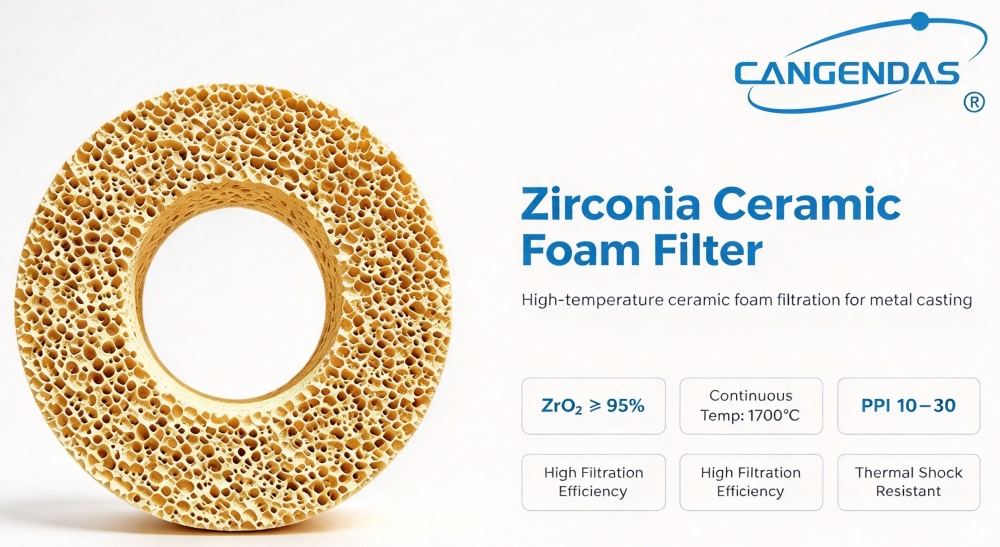
As steel flows through the interconnected pore network, the foam combines three capture mechanisms with flow straightening:
● Mechanical sieving. Particles larger than the pore openings — ladle slag agglomerates, eroded sand grains, and refractory wash fragments — are physically blocked at or near the entry face and accumulate there, gradually forming a filter cake that itself contributes to finer capture.
● Depth filtration (adsorption). This is the principal capture mechanism for clean steel. Fine deoxidation products — alumina clusters, manganese sulfide, and silicate particles — follow the tortuous path through the interconnected strut network. The metal repeatedly changes direction and velocity, so particles collide with the zirconia struts and adhere to the pore walls by surface-tension, chemical affinity, and van der Waals forces. Because capture occurs throughout the full thickness of the foam, inclusions considerably smaller than the nominal pore opening are retained.
● Filter cake formation. The coarse material retained on the entry face builds up a secondary layer that traps progressively finer particles as the pour continues; filtration efficiency increases as the campaign proceeds.
● Flow straightening. The porous foam breaks up the incoming stream into parallel sub-streams, lowering the Reynolds number and promoting laminar filling. With turbulence reduced after the filter, re-oxidation of the steel is held down, and mold erosion near the gate is reduced.
A temperature drop of about 10–20 °C across the filter should be allowed for in the pouring temperature, and flow rate is reduced by roughly 10–20% — pouring-time calculations should account for both.
| Item | Detail |
| Material | Partially stabilized zirconia (ZrO₂), MgO- or Y₂O₃-bonded |
| ZrO₂ content | ≥95% |
| Maximum application temperature | ~1700 °C continuous |
| Typical pouring range | Carbon steel 1550–1620 °C · Alloy steel 1560–1650 °C · Stainless steel 1580–1650 °C |
| Pore density | 10 / 15 / 20 / 30 PPI (custom PPI on request) |
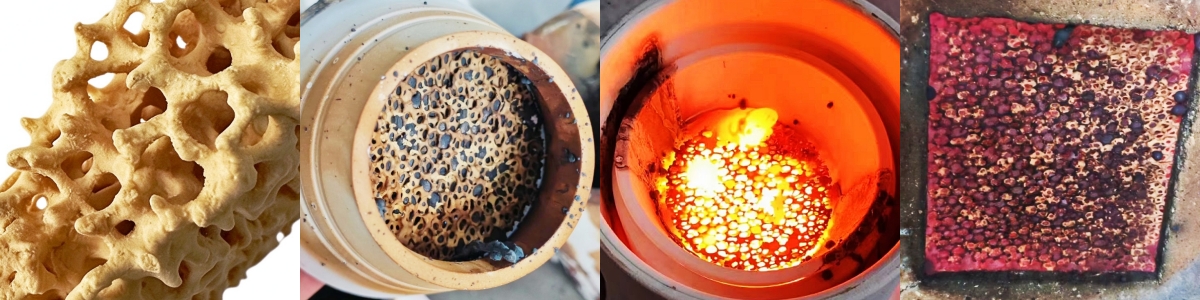
| Nominal pore opening | 10 PPI: 1.8–2.2 mm · 15 PPI: 1.4–1.6 mm · 20 PPI: 1.0–1.2 mm · 30 PPI: 0.7–0.9 mm |
| Porosity | 80–90% |
| Bulk density | 0.8–1.0 g/cm³ |
| Compressive strength | ≥1.5 MPa at room temperature |
| Thermal shock resistance | No cracking, 1700 °C to room temperature, 3 cycles |
| Color | Light yellow to cream |
| Shapes | Square, round, and custom geometric shapes |
| Size range | Standard square pads from 40 mm up; custom cut on request |
| Thickness | 10–30 mm typical |
| Single use | Yes, disposable |
| Preheat recommendation | Preheat for large or heavy castings; small pads may be used dry |
| Temperature drop across filter | ~10–20 °C; allow for in pouring temperature |
| Flow reduction | ~10–20%; adjust pouring time accordingly |
1. Casting processes
● Sand casting (green sand, resin sand, furan, no-bake) — primary application for carbon and alloy steel
● Investment casting (lost wax) — stainless steel and precision steel parts
● Permanent mold / gravity die — selected steel applications
2. Common castings
● Carbon and alloy steel: Suspension knuckles and control arms, valve bodies and Bonnets, pump housings, gear blanks, connecting rods, machine tool parts, pressure-tight housings, railroad and construction hardware
● Stainless steel: Pipe fittings, flanges, valve trim, pump and impeller parts, food and chemical hardware, investment-cast precision parts
● Superalloys (Ni-/Co-based): Selected high-temperature components where inclusion control is critical
3. Compatible alloys
● Carbon steels, low-alloy steels, medium-alloy steels
● Stainless steels (austenitic, martensitic, ferritic)
● Nickel- and cobalt-based superalloys
Quality Benefits for Foundries
Because capture occurs through the full foam depth and the high-temperature zirconia body contributes no fragments to the steel, foundries using zirconia foam filtration typically report:
● Fewer oxide inclusions, slag seams, and sand holes: fine deoxidation products below the nominal pore opening are retained together with coarse slag throughout the foam thickness
● In production steel-casting trials, scrap rates have been reported to fall substantially, and machined surface finish improves; results depend on incoming steel cleanliness, deoxidation practice, gating design, and PPI selection
● Longer cutting-tool life on steel free of hard alumina clusters and slag particles
● Fewer pressure-test leaks in valve bodies, pump housings, and pressure-tight castings, as oxide chains that form leak paths are removed in depth
● Reduced mold erosion and re-oxidation near the gate, because the flow is straightened to laminar after the filter
● No ceramic fragments or contamination introduced into the steel: the chemically inert zirconia body does not soften, react, or shed particles at pouring temperature
The filter is a single-use consumable: installed dry or preheated, discarded with the gating system after shakeout.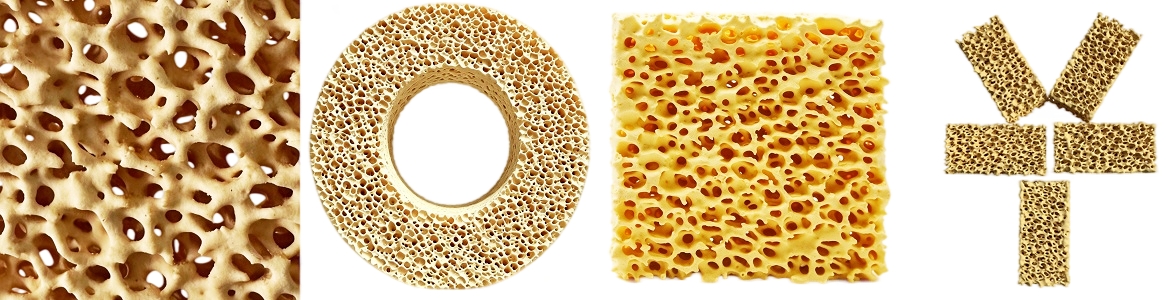
Application:
Suitable for carbon steel, alloy steel, stainless steel, and nickel- or cobalt-based superalloys.
Look forward to hearing from you:
Contact Us
+86 158 3011 4065
Guoruiyuan Building, ShengLi North Street, Chang'An District, Shijiazhuang City, Hebei Province, China.
Navigation
Navigation